
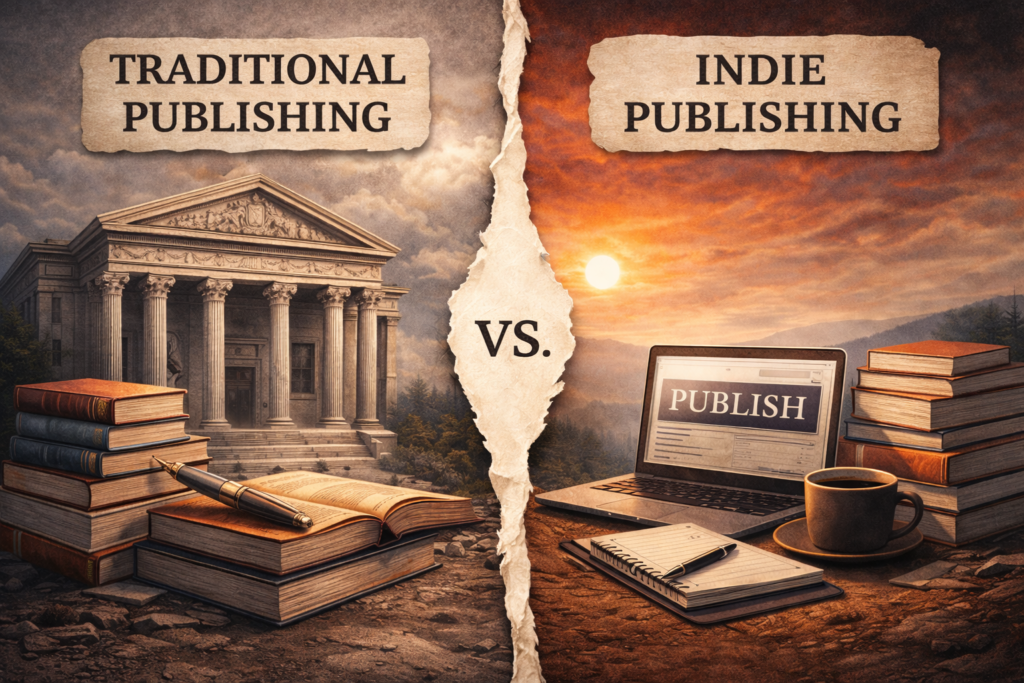
When I first finished Seasons of Ash, I did what most aspiring novelists are told to do. I wrote query letters. I researched agents. I polished my pitch. I sent about fifteen queries out into the world.
Then I waited.
After about a month, I received one rejection. The rest? Silence.
Now, one rejection in the publishing world is nothing. Fifteen queries is barely a dent. I knew that going in. I wasn’t discouraged. But while I was waiting, I started thinking. And I started doing the math.
The Waiting Game
Traditional publishing is slow. Not “a few months” slow. Years slow.
If an agent signs you, that can take months. Then they submit to publishers — more months. If a publisher buys it, you might wait another 12–24 months before the book actually hits shelves. That’s if everything goes right.
So I asked myself a simple question: What matters more to me — the validation of traditional publishing, or getting my work into readers’ hands now?
Because here’s what the timeline could have looked like: six months querying, six to twelve months on submission, and another twelve to twenty-four months before publication. That’s potentially two to three years before seeing the book in the world.
Or… I could publish now.
What I Really Wanted
When I stripped it down, this is what mattered to me: I wanted to learn from real readers. I wanted feedback — not hypotheticals. I wanted to see what resonated and what didn’t. I wanted to grow as a writer through iteration, not waiting.
I realized something important. In the time it might take to traditionally publish one book, I could write, publish, and learn from multiple books.
That matters.
Because writing is a craft. And craft improves through reps — not through silence.
The Revenue Question
There was also the business side to consider.
Traditional publishing offers distribution, prestige, and support — and those are real advantages. But it also means giving up a significant portion of revenue, losing control over timelines, and having limited say in pricing, marketing, and sometimes even creative direction.
I had to decide whether those tradeoffs were worth it for me.
For some authors, they absolutely are.
For me — at this stage — they weren’t.
I’d rather own the process. I’d rather own the timeline. I’d rather own the upside.
Speed as a Strategy
There’s another factor that tipped the scale: momentum.
If I waited years for one book, I’d still be at square one. But if I publish independently, I can release multiple books in the next 12–18 months, build an audience directly, grow my email list, improve my craft in real time, and adapt quickly based on feedback.
That kind of agility matters — especially in today’s publishing landscape.
This Isn’t a Rejection of Traditional Publishing
Let me be clear: I don’t think traditional publishing is wrong. I don’t think it’s dead. And I don’t think indie is automatically better.
This was simply the right move for me.
I didn’t make the decision out of frustration. I made it out of clarity.
I asked myself what I valued most: control, speed, learning, and ownership — or validation, institutional backing, and prestige.
Neither path is morally superior. But for where I am right now — as a writer who wants to grow, experiment, and move — indie publishing made more sense.
Pulling the Trigger
So I pulled the trigger.
I stopped querying. I published the book. And now it’s out in the world.
That feels good.
Now readers — not gatekeepers — get to decide. Now I get real feedback. Now I get data. Now I get growth.
And honestly?
I’m excited.
Because this isn’t the end of the journey.
It’s the beginning of a faster one.
—
If you’ve ever wrestled with the traditional vs. indie decision, I’d love to hear your thoughts. There’s no one right path — just the one that fits your goals.
And for me, right now, this one fits.
—
John Michael Layne