
Formally known as the National Radio Astronomy Obsevratory (NRAO)
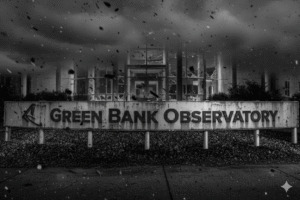
Green Bank Observatory: America’s Quietest Frontier for Listening to the Cosmos
Tucked into the Allegheny Mountains of West Virginia, the Green Bank Observatory (GBO) is where scientists turn down Earth’s noise to hear the universe. Home to the Robert C. Byrd Green Bank Telescope (GBT)—the world’s largest fully steerable radio telescope—this valley is both a cutting-edge research campus and a magnet for myths. Here’s the real story, the fun stuff, and the conspiracy chatter—sorted.
A quick background
Radio astronomy has lived in Green Bank since the late 1950s. The site was historically part of the National Radio Astronomy Observatory (NRAO) and, as of 2016, the Green Bank facilities have been operated independently by the Green Bank Observatory. The 100-meter GBT dominates the campus and can scan roughly 85% of the local sky across ~0.1–116 GHz, giving astronomers exquisite sensitivity to faint cosmic radio signals.
Green Bank also sits inside the 13,000-square-mile National Radio Quiet Zone (NRQZ), created in 1958 to shield radio research from powerful man-made transmitters. Within the Quiet Zone, fixed, licensed transmitters (think large towers) are coordinated or restricted to reduce interference that would swamp the telescopes.
Fun facts to wow your inner science nerd
• Biggest steerable dish on Earth. The GBT’s unblocked, 100-meter aperture makes it uniquely sensitive—one reason it gets thousands of hours of observing every year.
• Collapse and comeback. An earlier 300-foot (91 m) Green Bank telescope—once the world’s largest—dramatically collapsed in 1988 due to a failed gusset plate. The GBT rose in its place by 2000/2001.
• Listening for life. Green Bank is a core site for Breakthrough Listen, the largest modern search for extraterrestrial technosignatures. Roughly 20% of GBT time supports this project, which surveys a million nearby stars and more.
• Pulsars to gravitational waves. GBT’s precision pulsar timing feeds projects like NANOGrav, which uses pulsars to detect the gravitational-wave “hum” of the universe.
So what’s the deal with the “Quiet Zone”?
The Quiet Zone doesn’t mean locals can’t own phones or Wi-Fi. In the vast, 13,000-sq-mi NRQZ, restrictions mainly target powerful fixed transmitters (e.g., cellular or broadcast towers) that could point at the telescopes. Day-to-day consumer gadgets are common—especially outside the tightly protected area right around the dishes—and GBO has even worked with local schools on managed Wi-Fi solutions.
Closer to the instruments, on campus, rules get stricter. Even tiny leaks of radio noise—far weaker than a snowflake’s kinetic energy hitting the ground—can pollute sensitive observations, so on-site devices are tightly controlled.
Conspiracy Theories (or what if…)
1) “Green Bank enforces a high-tech blackout.”
Some claim that the National Radio Quiet Zone isn’t just about science—it’s a sweeping ban on all electronics. Phones, microwaves, wireless routers: the rumor goes that none of it works anywhere near Green Bank. Could it be that the Quiet Zone’s real purpose is to isolate the site from the rest of the world’s electromagnetic chatter?
2) “This is a secret NSA or intelligence installation in disguise.”
Given its remote setting, sensitivity to signals, and proximity to other government listening posts, some suggest Green Bank is more than just an observatory. Maybe the radio telescopes serve dual roles—both for astrophysics and covert surveillance. Could one scientific mission be covering the other?
3) “Sabotage, sabotage, sabotage.”
The famous 1988 collapse of the 300-foot telescope is commonly attributed to structural failure, but whispers persist: what if someone tampered with vital joints or components? Could internal sabotage have masked itself as a freak engineering accident?
4) “Alien encounters and secret shutdowns.”
Online lore sometimes connects unexplained shutdowns, sudden evacuations, or intensive security sweeps to extraterrestrial events. What if those dramatic responses were triggered by something picked up on the dish—not human, not terrestrial—but something else entirely?
5) “They got something—just not telling us.”
If Green Bank is scanning the skies for signs of life, what if it has already caught something strange—something too volatile or too ambiguous to announce? Did someone decide to keep the signal secret until it can’t be ignored?
Why Green Bank still matters
We live in a loud world. Car ignitions, Wi-Fi, satellites—everything shouts on the radio spectrum. Green Bank is one of the few places built to hush that din so we can study pulsars, map interstellar gas, time gravitational ripples, and yes—listen for the rarest signals that might betray company in the cosmos. That mix of quiet rigor and audacious curiosity is why Green Bank inspires both awe and urban legends.