
When I sat down to write Seasons of Ash, I knew one thing before I knew the plot, the characters, or even the ending:
The story had to take place in West Virginia.

Most post-apocalyptic fiction unfolds in major cities, deserts, or anonymous wastelands. But the Appalachian Mountains — rugged, ancient, mysterious — offer something deeper. Something truer. When the world collapses, survival doesn’t start with fire or weapons. It starts with community, terrain, grit, and memory. And there’s no place where those things run deeper than West Virginia.
In many ways, Appalachia isn’t just my backdrop.
It’s the third main character of the novel.
A Landscape Built for Survival
West Virginia is a state shaped by ridgelines, hollers, and winding roads. It’s a place where distance isn’t measured in miles but in time, elevation, and how many switchbacks you have to navigate to get there.
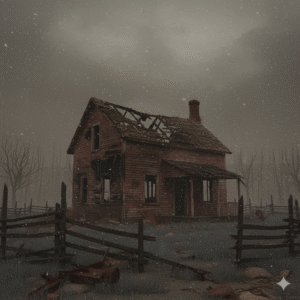
When civilization fails, this kind of terrain becomes both a refuge and a crucible:
- Mountains that hide you — and isolate you
- Rivers that sustain you — and trap you
- Roads that connect small towns — and narrow enough to defend
- Valleys that keep secrets — and amplify danger
In Seasons of Ash, the landscape is never passive. Ash drifts through forgotten hollers. Fog settles like a curtain across ridgetops. Every mile of Matt Anderson’s journey reminds him how small one person can feel in a world this vast and wild.
This is what makes Appalachia perfect for an end-of-the-world story:
The land itself tests you.
The Strength of Small Towns
Green Bank, Cass, and the surrounding towns of Pocahontas County aren’t just settings — they’re reflections of a distinctly Appalachian brand of resilience.
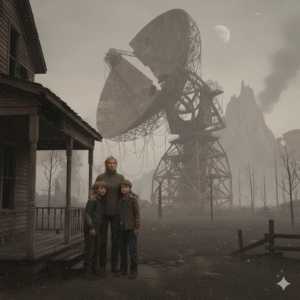
- Everybody knows somebody who can fix something.
- Neighbors check on each other before they check the news.
- People argue, disagree, and feud — but when trouble hits, they band together.
In the novel, Laura’s fight to hold her community together mirrors what many West Virginians already understand: survival isn’t just individual. It’s collective. It’s messy. It’s human.
And when resources vanish and chaos spreads, a strong community becomes the most powerful asset you have.
The Green Bank Observatory: A Place Already Quiet
One of the most compelling reasons I chose this setting is the Green Bank Observatory, sitting inside the National Radio Quiet Zone — 13,000 square miles where wireless signals are heavily restricted.
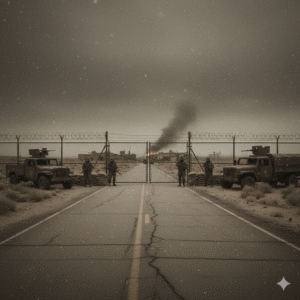
It already feels like a place halfway between two worlds:
- advanced science
- deep rural silence
- cutting-edge astrophysics
- old farming communities
- a giant radio telescope towering over a tiny mountain town
In a post-apocalyptic world, Green Bank becomes more than a scientific site.
It becomes a place where communication goes dark long before the rest of the world realizes something’s wrong.
Its silence becomes story fuel.
A Personal Connection to These Mountains
I’m a native West Virginian, and no matter where life has taken me — from the Marine Corps to corporate boardrooms to quiet evenings writing — these mountains have always felt like home.
Writing Seasons of Ash was, in many ways, a tribute:
- to the people who raised me
- to the hardworking men and women who keep the lights on
- to the families who choose community over convenience
- to the landscapes that shape character as much as any hardship
The authenticity readers feel in this book comes from lived experience — not postcard Appalachia, not stereotypes, but the real heartbeat of the state.
A Story That Could Only Happen Here
Could Seasons of Ash have taken place somewhere else?
Maybe.
Would it have felt the same?
Absolutely not.
West Virginia offers:
- isolation without emptiness
- danger without hopelessness
- rugged beauty without artifice
- community without pretense
It’s a place where survival isn’t theoretical — it’s generational.
And that’s the soul of this novel.
Closing Thoughts
In Seasons of Ash, the world ends — but West Virginia endures.
Not untouched, not unscarred, but unbroken.
These mountains have seen fire, flood, war, and hardship.
They’ve watched generations rise and fall.
They’ve held stories older than the nation itself.
Setting my novel here wasn’t a creative choice.
It was a necessity.
Because when the ash settles, the Appalachian spirit is exactly the kind of strength the world needs to rebuild.